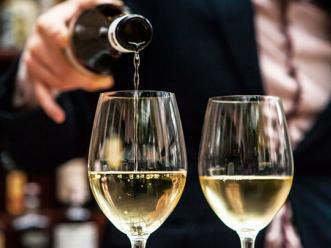
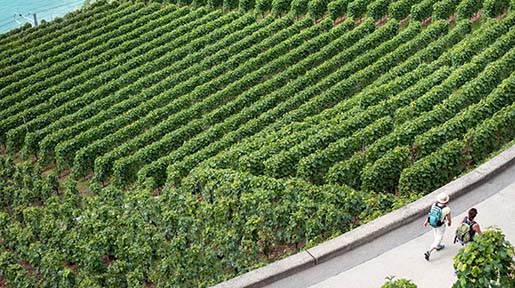
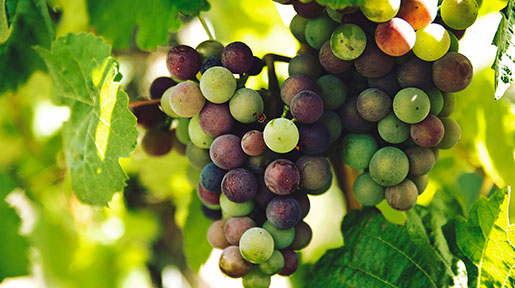
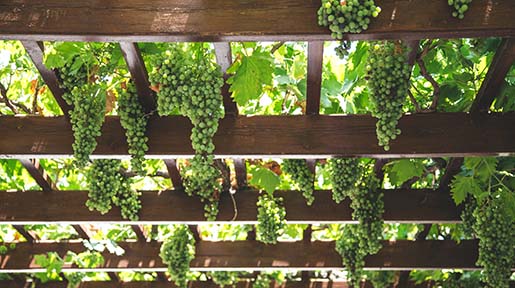
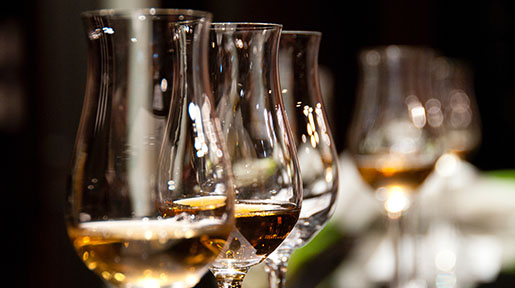
So – my wife and I started a wine club in the Monterey/Carmel area. It’s called The Tannin Salon. We meet religiously (kind-of) on the third Saturday of every month – there’s about twenty of us. Every meeting we focus on a different variety or region. No matter what the theme is, each meeting is always a lot of fun. It’s an edu-taining of the senses and a great way to engage wine seriously in a relaxed atmosphere.
This morning, I’m learning about my own ability to taste. In particular the spacing of my taste buds. I’m staring into a mirror. I think this is silly. But the author of a How-To-Start-Your-Own-Wine-Club book suggests a drop of blue food coloring on my tongue will help me more precisely assess my potential organoleptic abilities. I think the author is testing my gullibility ratio. Apparently, I score rather high.
I drop the food coloring on my tongue. It’s an instantaneous mess. My entire tongue is now blue. My teeth are blue. My lips too. I am more interested in cleaning up than investigating the spacing of taste buds on my tongue (the dye tastes awful).
When I do get around to examining the spacing of my taste buds – I have rather tightly spaced miniature buds – it is as I expected. According to the author of my dye-debacle, smaller buds are more receptive than larger buds. This is simply due to the number of buds that can fit within the confines of the surface of the tongue. In this regard, I am blessed. But I also have blue tongue.
Tasting wine is more than just the size of your taste buds. It’s about knowing the wine in front of you. That includes, but is not limited to the region it comes from, the vintage, the vineyard practices and yield of fruit per acre/hectare, vinification practices and scores of other qualifiers which may or may not have a bearing on your enjoyment of the actual wine product.
In all seriousness, you don’t have to go as deep as all of that. Wine tasting can and typically is a lot less intellect and a lot more sensory evaluation.
First and foremost, a lot can be learned about a wine from its label. But what if you’re tasting a wine blindly, or without knowing what it is before you actually taste it – like in black glass tastings? Where would you even begin?
What I try to focus on when tasting any wine are my own five senses, and I have learned to trust my senses for all of their faults and fortitude.
Typically, I start with the sense of touch. Is the wine cold, or at room temperature? (For maximum wine enjoyment, reds should be served at room temperature, whites slightly chilled) Is it sparkling? (Some sparklers, like Txacoli, are very slow percolators and listening to the glass actually helps identify it, especially when blind tasting) Is it red or white? How red or white? Is it pink? How does it smell? And finally, how does it taste?
This is all part of “tasting” any wine because tasting wine is not only about putting wine in your mouth. “Tasting” is about identifying the nuances of a wine through a tangible interaction with it. That interaction involves more than just the mouth.
Tasting a wine truly begins with the sense of smell. Try plugging your nose and tasting a wine, you literally can’t taste much if anything. The sense of smell is paramount to understanding a wine. I try to focus a lot of attention here, on the nose.
One way to do that is to postpone sipping a wine until you have been able to identify a few qualifying characteristics of aroma – richness of fruit, age, and any individual varietal expressions. This is a crucial step in learning about variety and terroir. Put your nose in the top of the glass and smell the wine.
As a test, taste a Napa cabernet sauvignon against a Bordeaux cabernet sauvignon. Noticeably, there will be similar and dissimilar aromatic characteristics. It’s the same grape essentially, but each wine experienced different soil, different weather, different styles of winemaking. The same goes for any variety made in two different parts of the world. There will be similarities and variations.
As for that liquid rolling around in your mouth, saturating your taste buds, now it’s time to focus.
A quick swirl around the mouth should do, then down it. Notice how your mouth reacts. Do the tannins dry your tongue? Does the acidity force you to salivate? (Saliva is a base/alkaline solution with a pH of about 7.4. Salivation is the body’s response to potentially harmful acids that occur naturally in food.) Does the wine attach itself to any particular part of your tongue and stay there? Does it roll off and leave an enriched sensation? Can you taste it long after you’ve swallowed? Does the heat of the alcohol overwhelm the flavors of the wine? How does your mouth feel?
Ideally, a second sip of wine will arrive in the mouth shortly after a brief inhalation of its aroma – what I mean to suggest is, smell it and taste it in a single and orderly effort. A third sip should arrive the same way, as a totality of smell (first) and taste (second).
Next, note the nuances of the aromas and the flavors combined. Now, attempt identify what some of them are. (A good way to learn the vocabulary of wine is to pick up a tasting wheel.) Then ask yourself a few important questions about the wine.
Is it a true expression of the variety that it claims to be? Some wines are blends and therefore require varying potential criticisms. The more familiar you are with a variety the more you can explore its variations.
Moving on from variety, are there any prominent oddities such as too much oak? Is the experience pleasant? Do you want more?
Essentially, the fun in “tasting” wine enjoying what wine exemplifies: Nature as sustenance (gastronomy); community (meals with friends/family); geography (region); history (wine is as old as the written word).
The first step, perhaps, is understanding the abilities and limitations of your own senses. The best way to do that is to test them. The best way to test them is to taste wine, continuously … in my opinion.
No matter how good your tasting abilities might be, they can only be improved by learning/tasting more. Examining wine should not finish with the conclusion that it is a beverage of varying quality made from grapes.
Wine is as much a refreshment as it is a piece of human culture and history ... of course, it depends how deeply you dive into the subject. However, even an earnest hobbyist who joins or starts a wine club will be surprised at just how much can be gleaned from an organized tasting regimen.
My own regimen, for 2008, includes but is not limited to twelve wine club events (an average of 10 wines per event), one different variety every week on my own (52 varieties, plus variations within each), plus weekly tastings at the winery where I work, and several tasting engagements scheduled throughout the year. It sounds daunting, I know, but I can think of worse things on which to spend my time.